
Beat Creative Fatigue on Meta Ads Before It Kills Your ROAS
Creative fatigue is one of the most common reasons cost per acquisition quietly climbs in Meta Ads Manager. Week one looks fine. By week four, the same static image that converted efficiently is costing more per purchase — often because frequency rose and click-through rate fell, not because your targeting suddenly broke.
The fix is not pausing and relaunching every ad set. It is building a rotation system: Dynamic Creative, monitoring frequency in Ads Manager, and introducing new hooks before performance drops.
Signs your Meta ad creative is fatiguing
Creative fatigue is audience saturation. When the same person sees your ad multiple times in a short window, they stop clicking. Meta's delivery system interprets lower engagement as a quality signal and CPM often rises while CTR falls — CPA follows.
In Ads Manager, pull metrics at the ad level (not just ad set):
| Signal | What to check |
|---|---|
| Rising frequency | Frequency > ~2.5 on prospecting audiences |
| Falling CTR | Week-over-week CTR drop on the same ad |
| Rising CPA/CPR | Cost per result up while CPM also climbs |
Triple Whale's e-commerce benchmark data (Aug 2025–Jul 2026) shows median CPA of $38.99 and median CTR of 2.39% across Meta campaigns (Triple Whale benchmarks). Use your own account history as the primary benchmark — industry medians are context, not targets.
Using Dynamic Creative to fight ad fatigue
Meta's Dynamic Creative documentation explains that you upload multiple creative elements — images, videos, headlines, primary text — and Meta automatically combines them into ad variations for your audience. The system learns which combinations perform best.
Meta's developer docs note Dynamic Creative is intended for campaigns running longer than five days so the system has time to test combinations (Meta Dynamic Creative API).
Practical setup for fashion brands:
- Upload 3–5 genuinely different visuals (UGC hook vs product close-up vs on-model walk).
- Add 2–3 headline variants and 2 primary-text options.
- Let the system run at least 5–7 days before judging winners.
- Replace bottom-quartile combinations; promote winners to standalone ads.
Note: Meta has updated some campaign workflows — Dynamic Creative availability varies by objective and account. Check Ads Manager for "Advantage+ creative" or flexible ad format options if Dynamic Creative is not shown for your campaign type.
- Single static creative ($)
- Rotating creative pool ($)
Chart methodology: The chart above illustrates a common account-level pattern observed when a single creative fatigues versus when multiple assets rotate. It is not sourced from a single published study. Validate against your own ad-level CPA and frequency data in Ads Manager.
Setting up a creative rotation workflow
Meta's Advantage+ sales campaigns best practices recommend providing a wide variety of diverse creative assets to maximize performance — this directly addresses fatigue by giving the system alternatives when one asset declines.
A rotation workflow for fashion e-commerce:
- Identify a winning body — video that holds attention past ~3 seconds (check hold rate in Ads Manager).
- Produce 3–5 new opening hooks — same body, different first 2 seconds.
- Launch in Dynamic Creative or a dedicated testing ad set with broad or Advantage+ audience.
- Pause ads below your hook-rate threshold after ~1,000 impressions.
- Scale budget on winners only after frequency stays stable for 48+ hours.
AI creative tools can accelerate hook production when you need volume — but the principle is the same as manual production: test meaningfully different assets, not synonym swaps on identical visuals.
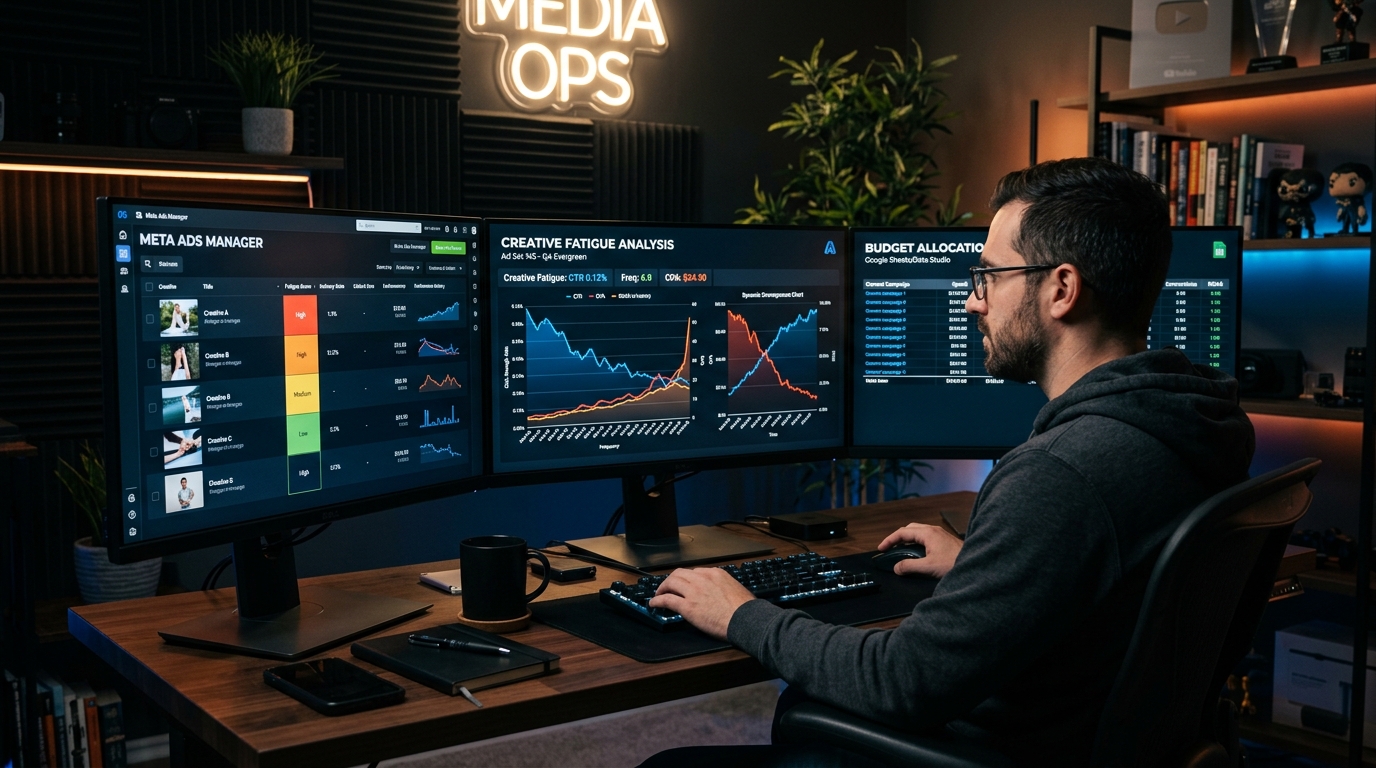
Frequency: what Meta does and does not publish
Meta does not publish a universal "optimal frequency cap" for all advertisers. Frequency is a diagnostic metric in Ads Manager, not a fixed setting for all campaign types. On prospecting, many practitioners watch for frequency rising above ~2.5 combined with CTR decline; on retargeting, slightly higher frequency is normal because the audience is smaller and already familiar with the brand.
Pair frequency monitoring with creative rotation — capping reach without new assets only limits delivery; it does not fix a tired message.
Weekly creative refresh checklist
Every Monday, review ad-level data for the past seven days:
- Flag ads where frequency rose and CTR fell week over week
- Pause underperformers below breakeven ROAS after sufficient impressions
- Add 2–3 new hook variants to Dynamic Creative or testing ad sets
- Confirm purchase events still fire in Events Manager
- Check that significant edits (budget, audience, optimization event) did not reset learning unnecessarily (significant edits guide)
Wrapping up
Creative fatigue is predictable: static assets decay as frequency rises. Meta's own guidance points toward diverse creative supply (Advantage+ best practices) and automated combination testing (Dynamic Creative). Build a weekly pipeline of new hooks, monitor frequency and CTR at the ad level, and treat industry CPA medians as context — your Ads Manager data is the source of truth.
Frequently asked questions
What is creative fatigue on Meta ads?
Creative fatigue occurs when the same audience sees the same ad repeatedly, CTR declines, and cost per result rises. Meta's delivery system may then charge higher CPMs because lower engagement signals lower ad quality. Monitor frequency and CTR together in Ads Manager.
How does Meta Dynamic Creative help with fatigue?
Dynamic Creative lets you upload multiple images, videos, headlines, and primary text options; Meta automatically combines them into ad variations and allocates delivery toward better-performing combinations. See Meta's help article on dynamic creative for setup requirements.
When should I refresh Meta ad creative?
Refresh when ad-level frequency rises (often above 2.5 on cold audiences) while CTR drops week over week — not on a fixed calendar alone. Meta's Advantage+ sales guidance also recommends supplying diverse creative assets continuously rather than relying on one static asset.